← Back to News
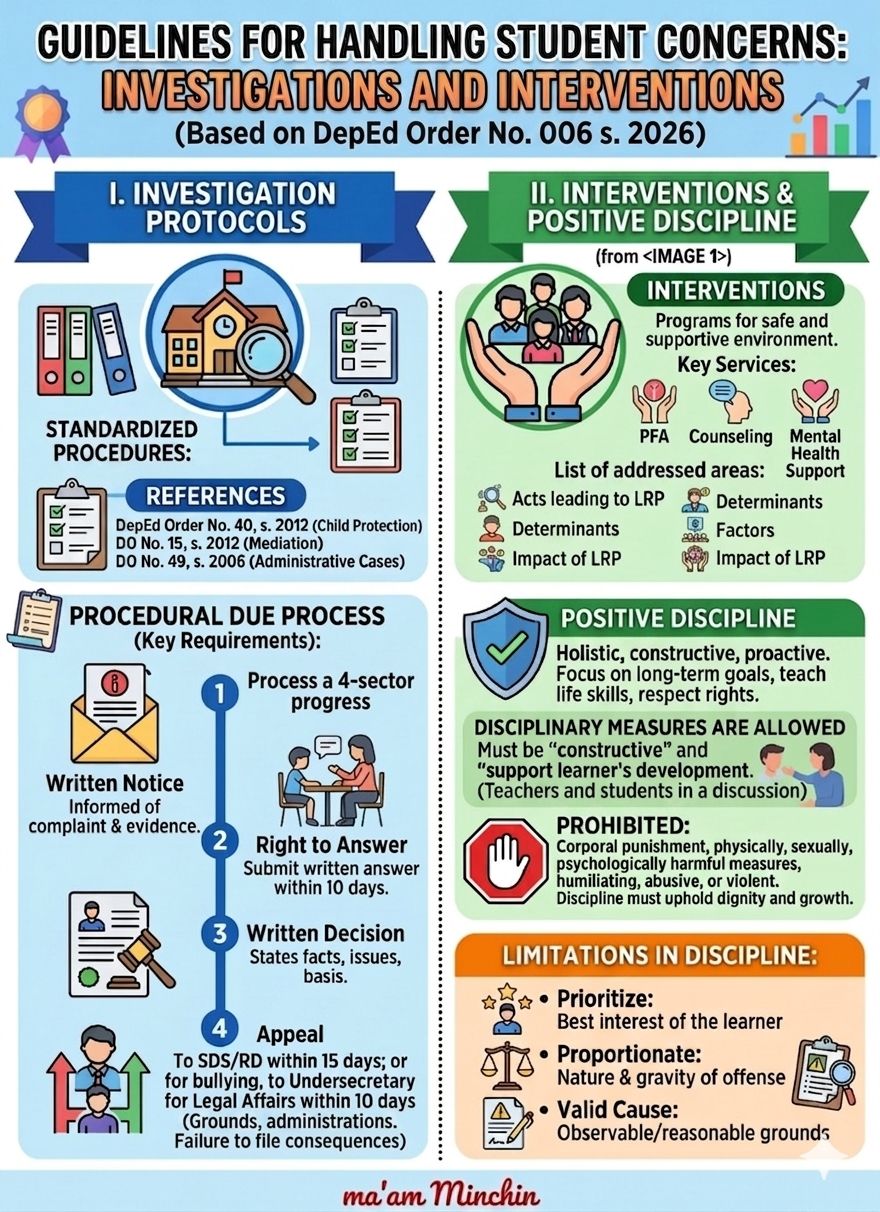
Investigations and Interventions**
Based on DepEd Order No. 006, s. 2026
To ensure learner protection, fairness, and accountability, the Department of Education provides clear guidelines for handling student concerns through proper investigation protocols and positive, development‑focused interventions. These guidelines uphold due process while promoting a safe and supportive school environment.
I. Investigation Protocols
Standardized Procedures
All student concerns must be addressed using standardized investigation procedures anchored on existing DepEd policies, including:
DepEd Order No. 40, s. 2012 – Child Protection Policy
DepEd Order No. 15, s. 2012 – Mediation
DepEd Order No. 49, s. 2006 – Administrative Cases
These ensure consistency, legality, and protection of all parties involved.
Procedural Due Process
To safeguard the rights of learners, the following steps must be observed:
Written Notice
The learner and concerned parties must be formally informed of the complaint and supporting evidence.
Right to Answer
The respondent is given the opportunity to submit a written explanation within ten (10) days.
Written Decision
A formal decision is issued stating the facts, issues, and legal basis of the findings.
Right to Appeal
Appeals may be filed with the Schools Division Superintendent (SDS) or Regional Director (RD) within 15 days
For bullying cases, appeals may be elevated to the Undersecretary for Legal Affairs within 10 days
Failure to file within the prescribed period carries corresponding consequences.
II. Interventions and Positive Discipline
Supportive Interventions
Schools shall implement programs that foster a safe, caring, and supportive environment, including:
Psychological First Aid (PFA)
Counseling Services
Mental Health Support
Interventions address:
Acts leading to learner rights violations
Contributing determinants and risk factors
Short‑ and long‑term impact on learners
Positive Discipline
Discipline must be:
Holistic, constructive, and proactive
Focused on long‑term goals, life skills development, and respect for learners’ rights
Implemented through dialogue and guided discussion involving teachers and learners
✅ Allowed Disciplinary Measures:
Measures that are constructive and supportive of learner development
🚫 Prohibited Measures:
Corporal punishment
Physical, sexual, or psychologically harmful acts
Humiliating, abusive, or violent discipline
All disciplinary actions must uphold the dignity, rights, and growth of the learner.
Limitations in the Imposition of Discipline
Disciplinary actions must always be:
Learner‑Centered – prioritizing the best interest of the learner
Proportionate – appropriate to the nature and gravity of the offense
With Valid Cause – based on observable and reasonable grounds
Conclusion
The guidelines for handling student concerns emphasize due process, fairness, and restorative discipline. By combining proper investigation procedures with positive and supportive interventions, schools ensure accountability while nurturing learners’ well‑being, growth, and protection.
**Guidelines for Handling Student Concerns:
Investigations and Interventions**
Based on DepEd Order No. 006, s. 2026
To ensure learner protection, fairness, and accountability, the Department of Education provides clear guidelines for handling student concerns through proper investigation protocols and positive, development‑focused interventions. These guidelines uphold due process while promoting a safe and supportive school environment.
I. Investigation Protocols
Standardized Procedures
All student concerns must be addressed using standardized investigation procedures anchored on existing DepEd policies, including:
DepEd Order No. 40, s. 2012 – Child Protection Policy
DepEd Order No. 15, s. 2012 – Mediation
DepEd Order No. 49, s. 2006 – Administrative Cases
These ensure consistency, legality, and protection of all parties involved.
Procedural Due Process
To safeguard the rights of learners, the following steps must be observed:
Written Notice
The learner and concerned parties must be formally informed of the complaint and supporting evidence.
Right to Answer
The respondent is given the opportunity to submit a written explanation within ten (10) days.
Written Decision
A formal decision is issued stating the facts, issues, and legal basis of the findings.
Right to Appeal
Appeals may be filed with the Schools Division Superintendent (SDS) or Regional Director (RD) within 15 days
For bullying cases, appeals may be elevated to the Undersecretary for Legal Affairs within 10 days
Failure to file within the prescribed period carries corresponding consequences.
II. Interventions and Positive Discipline
Supportive Interventions
Schools shall implement programs that foster a safe, caring, and supportive environment, including:
Psychological First Aid (PFA)
Counseling Services
Mental Health Support
Interventions address:
Acts leading to learner rights violations
Contributing determinants and risk factors
Short‑ and long‑term impact on learners
Positive Discipline
Discipline must be:
Holistic, constructive, and proactive
Focused on long‑term goals, life skills development, and respect for learners’ rights
Implemented through dialogue and guided discussion involving teachers and learners
✅ Allowed Disciplinary Measures:
Measures that are constructive and supportive of learner development
🚫 Prohibited Measures:
Corporal punishment
Physical, sexual, or psychologically harmful acts
Humiliating, abusive, or violent discipline
All disciplinary actions must uphold the dignity, rights, and growth of the learner.
Limitations in the Imposition of Discipline
Disciplinary actions must always be:
Learner‑Centered – prioritizing the best interest of the learner
Proportionate – appropriate to the nature and gravity of the offense
With Valid Cause – based on observable and reasonable grounds
Conclusion
The guidelines for handling student concerns emphasize due process, fairness, and restorative discipline. By combining proper investigation procedures with positive and supportive interventions, schools ensure accountability while nurturing learners’ well‑being, growth, and protection.