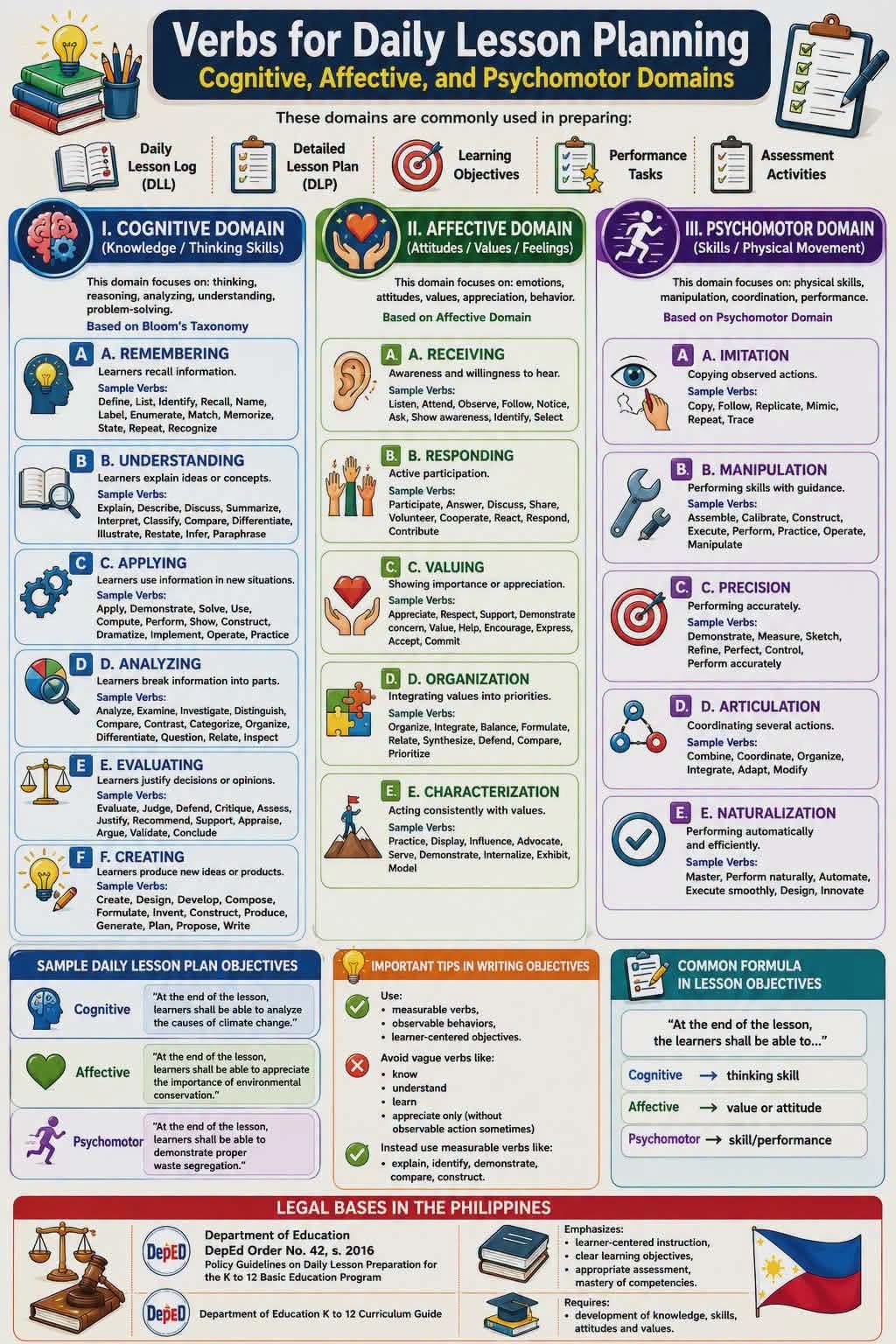
Effective lesson planning requires the use of clear and measurable objectives that guide both teaching and assessment. These objectives are commonly designed using three learning domains: cognitive, affective, and psychomotor.
The cognitive domain, based on Bloom’s Taxonomy, focuses on thinking skills. It includes levels such as remembering, understanding, applying, analyzing, evaluating, and creating. Each level uses specific verbs like define, explain, apply, analyze, evaluate, and create to describe what learners should achieve. This domain emphasizes intellectual development and problem-solving abilities.
The affective domain deals with learners’ attitudes, values, and emotions. It progresses from receiving and responding to valuing, organizing, and characterizing. Verbs such as listen, participate, appreciate, organize, and demonstrate are used to describe behaviors that reflect personal growth and social responsibility. This domain highlights the importance of values formation and emotional engagement.
The psychomotor domain focuses on physical skills and coordination. It includes stages such as imitation, manipulation, precision, articulation, and naturalization. Verbs like copy, perform, demonstrate, coordinate, and master describe skill development and execution. This domain is essential for tasks that involve hands-on performance and technical skills.
When writing lesson objectives, teachers are encouraged to use measurable and observable verbs instead of vague ones like understand or know. A common structure for objectives is:
“At the end of the lesson, learners shall be able to…” followed by a verb that aligns with the targeted domain.
Ultimately, integrating these three domains ensures holistic learning by developing knowledge, shaping attitudes, and enhancing skills.